
Overview of GST Registration in India
GST (Goods and Services Tax) registration is a mandatory requirement for businesses involved in the supply of goods or services once they cross the prescribed turnover limits. It applies to:
-
Manufacturers
-
Traders
-
Service providers
-
E-commerce sellers
-
Freelancers
-
Businesses operating online or across multiple states
GST was introduced to consolidate multiple indirect taxes into a single unified tax system. Before GST, businesses had to comply with VAT, excise duty, service tax, and various state-level taxes, making compliance complex. GST simplified this by creating one tax framework on the supply of goods and services.
What Is GST Registration?
GST registration is the process by which a business or individual is registered under the GST law and issued a GSTIN (Goods and Services Tax Identification Number). This 15-digit unique number authorizes the business to collect GST from customers and deposit it with the government.
GST registration enables businesses to:
-
Collect GST legally
-
Claim Input Tax Credit (ITC)
-
Expand operations across India
-
Remain compliant with GST laws
GST follows a value-added tax system, where tax is levied at each stage of the supply chain.
Types of GST Registration in India
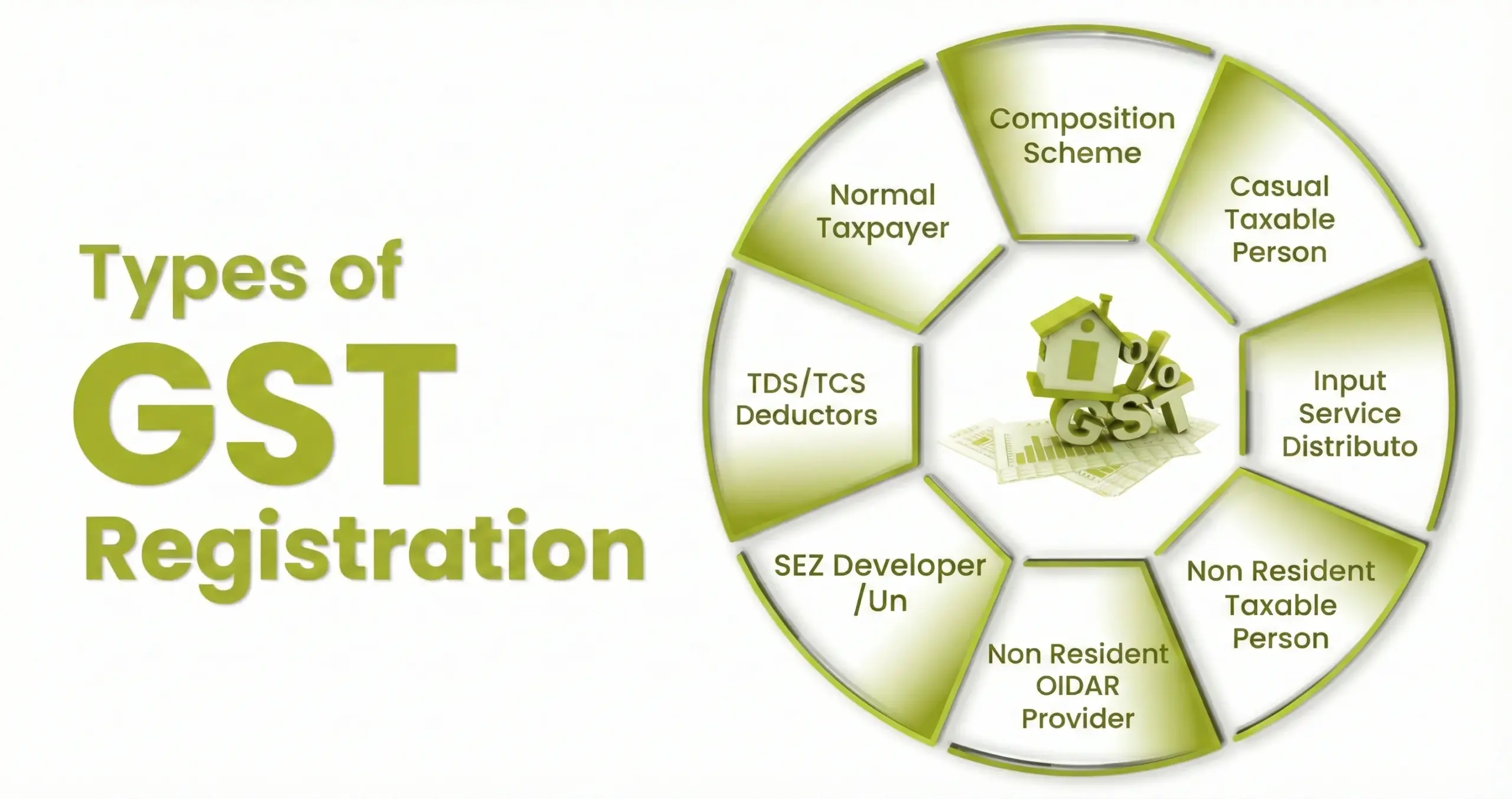
Normal Taxpayer Registration
For regular businesses exceeding the turnover threshold. Allows GST collection, ITC claims, and standard compliance.
Casual Taxable Person
For businesses operating temporarily or seasonally. Valid for 90 days and extendable once.
Non-Resident Taxable Person
For foreign entities supplying goods or services in India without a permanent business establishment.
Non-Resident Online Service Provider
For overseas digital service providers offering online services to Indian customers.
SEZ Developer / Unit
For businesses operating in Special Economic Zones, offering export-related benefits and tax exemptions.
TDS / TCS Registration
For entities required to deduct or collect GST at source.
Components of GST: CGST, SGST, IGST & UTGST
India follows a dual GST structure:
-
CGST: Levied by the Central Government on intra-state supplies
-
SGST: Levied by the State Government on the same transaction
-
IGST: Applicable on inter-state supplies and imports
-
UTGST: Applicable in Union Territories without legislatures
GST Registration Threshold & Turnover Limits
GST registration becomes mandatory once turnover exceeds the prescribed limits.
Turnover Threshold Table
| Type of Supply | Normal Category States (₹) | Special Category States (₹) |
|---|---|---|
| Goods | 40 Lakhs | 20 Lakhs |
| Services | 20 Lakhs | 10 Lakhs |
| Goods & Services | 20 Lakhs (service portion) | 10 Lakhs (service portion) |
Special category states include Arunachal Pradesh, Assam, Himachal Pradesh, Jammu & Kashmir, Manipur, Meghalaya, Mizoram, Nagaland, Puducherry, Sikkim, Tripura, and Uttarakhand.
Key Benefits of GST Registration in India
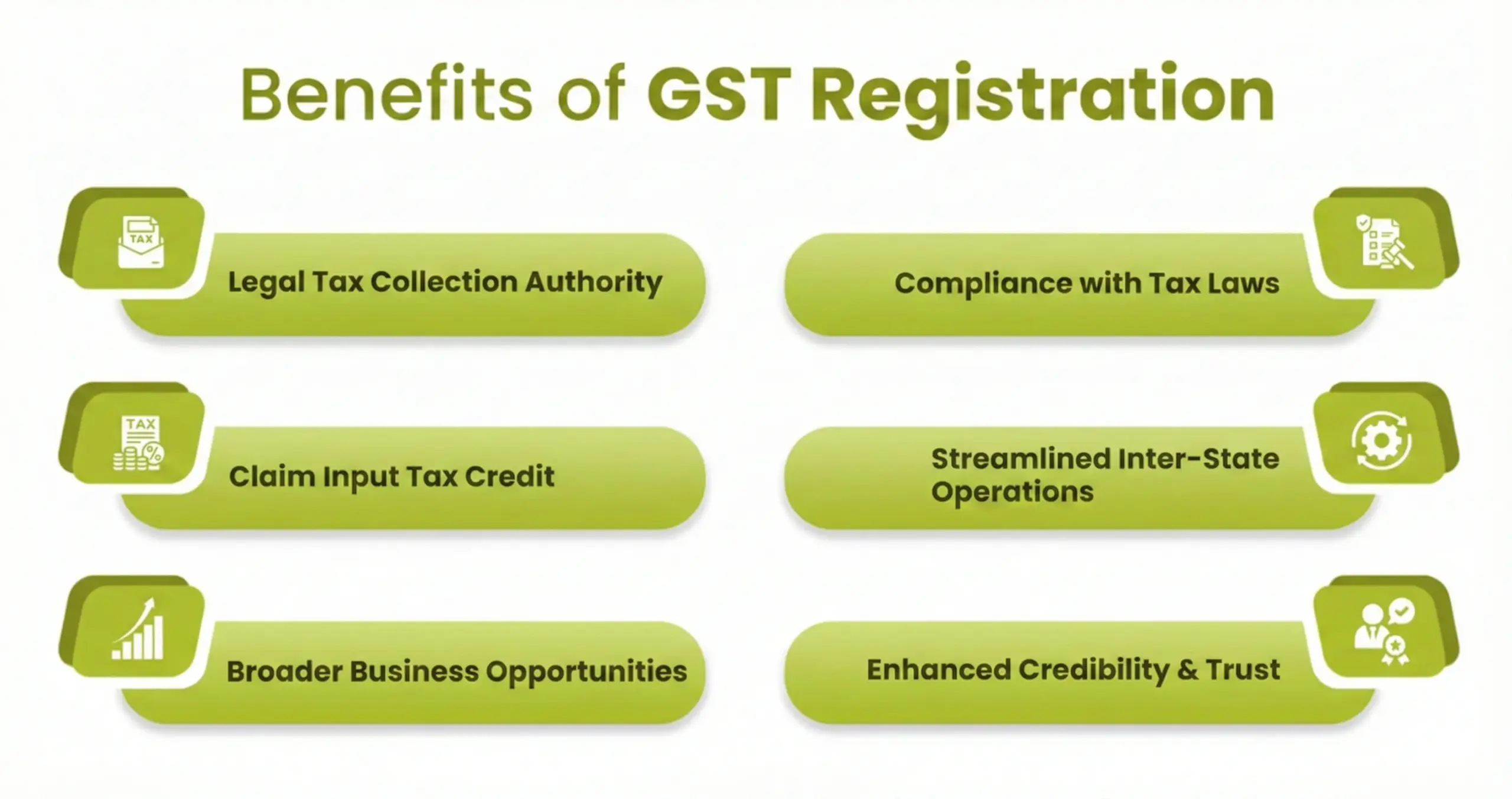
Legal Tax Collection & Credibility
GST registration allows businesses to legally collect tax and issue GST invoices, improving transparency and trust.
Input Tax Credit (ITC)
Businesses can claim GST paid on purchases, reducing overall tax liability and improving cash flow.
Wider Business Opportunities
GST registration enables participation in government tenders, B2B contracts, inter-state trade, and e-commerce.
Legal Compliance
Staying GST-compliant avoids penalties and simplifies audits.
Business Expansion
GST removes state-wise tax barriers and supports nationwide operations.
Who Is Eligible for GST Registration?
You are eligible or required to register if:
-
Turnover exceeds ₹40 lakh (goods) or ₹20 lakh (services)
-
You supply goods/services across states
-
You sell through e-commerce platforms
-
You are a casual or non-resident taxable person
-
You are liable under reverse charge mechanism
-
You act as ISD or agent
-
You provide OIDAR services from outside India
Voluntary registration is also permitted below threshold limits.
Mandatory GST Registration for Specific Businesses
GST registration is compulsory for:
-
Casual taxable persons
-
Non-resident taxable persons
-
Inter-state suppliers
-
E-commerce operators and sellers
-
Agents of registered taxpayers
-
Reverse charge liable entities
-
ISDs
-
TDS/TCS deductors
-
Aggregators (ride-hailing platforms, etc.)
-
Businesses migrated from VAT, Excise, or Service Tax
Voluntary GST Registration – Why Opt In?
-
Claim ITC
-
Build credibility
-
Sell across India
-
Enable e-commerce selling
-
Support scaling and tenders
-
Carry forward legacy tax credits
-
Improve loan and rental eligibility
Choosing the Right GST Scheme
Regular Scheme vs Composition Scheme
| Criteria | Regular Scheme | Composition Scheme |
|---|---|---|
| Turnover Limit | Mandatory above threshold; no upper limit | Up to ₹1.5 Cr (₹75L for special states) |
| ITC | Allowed | Not allowed |
| Tax Rates | 5%, 12%, 18%, 28% | Fixed (1%, 5%, 6%) |
| Compliance | High | Low |
| Invoice Type | Tax Invoice | Bill of Supply |
| Inter-State Sales | Allowed | Not allowed |
| E-commerce | Allowed | Not allowed |
| Best For | Medium/large, B2B, e-commerce | Small, B2C, local |
Documents Required for GST Registration
-
PAN Card
-
Aadhaar Card
-
Business address proof
-
Bank account details
-
Passport-size photographs
-
Digital Signature Certificate (DSC)
-
Authorization letter / Board resolution
(Additional documents may apply based on entity type.)
Step-by-Step GST Registration Process
-
Generate TRN
-
Login using TRN
-
Access saved application
-
Enter business details
-
Add promoter/partner details
-
Add authorized signatory
-
Enter business address
-
Add goods/services with HSN/SAC
-
Submit bank details
-
Provide state-specific info
-
Aadhaar authentication
-
Final submission → ARN generated
GST Registration Timeline & Validity
-
With Aadhaar Authentication: 3–7 working days
-
Without Aadhaar Authentication: 21–30 days
Validity
-
Regular taxpayers: Permanent
-
Casual taxable persons: 90 days (extendable)
-
Non-resident taxable persons: Limited duration
GST Registration Fees & Penalties
-
Government fee: Nil
-
Security deposit (Casual / NRTP): ₹500–₹10,000
Penalties
-
₹10,000 or 10% of tax due
-
Fraud cases: ₹10,000 or 100% of tax due
GST Cancellation & Renewal
Regular GST registrations do not expire if compliance is maintained. Temporary registrations require extension or fresh registration.
Cancellation may be:
-
Voluntary
-
Officer-initiated (non-compliance or fraud)
Final return (GSTR-10) must be filed before cancellation.
Post-Registration GST Compliance
-
Update GST details
-
Maintain records (6 years)
-
Issue GST invoices
-
File GST returns
-
Pay collected GST
-
Generate e-way bills
-
Apply correct HSN/SAC codes
| Form Name | Applicable For | Frequency | Due Date | Purpose |
|---|---|---|---|---|
| GSTR-1 | All normal registered taxpayers (outward supplies) | Monthly / Quarterly (QRMP) | 11th of next month (Monthly) / 13th after quarter (Quarterly) | To report details of outward supplies (sales) during the tax period. |
| GSTR-2A / GSTR-2B | Auto-drafted statement of inward supplies (purchases) | Monthly | Dynamic (2A) / 12th of next month (2B) | To view and reconcile Input Tax Credit based on suppliers’ filings. |
| GSTR-3B | All normal registered taxpayers (summary return) | Monthly / Quarterly (QRMP) | 20th of next month / 22nd or 24th after quarter | Summary of sales, purchases, ITC claimed, tax payable, and payment. |
| GSTR-4 | Composition Scheme taxpayers | Quarterly | 18th of the month following the quarter | Quarterly declaration of turnover and tax payable by composition dealers. |
| GSTR-9 | All normal registered taxpayers (annual return) | Annually | 31st December of the following financial year | Annual reconciliation of GST returns. Mandatory if turnover exceeds ₹2 crore. |
| GSTR-10 | Taxpayers with cancelled GST registration | One-time (Final Return) | Within 3 months of cancellation order | Final return to clear pending liabilities after cancellation. |
| GSTR-5 | Non-Resident Taxable Persons | Monthly | 20th of next month | Details of outward and inward supplies by non-resident taxpayers. |
| GSTR-6 | Input Service Distributors (ISD) | Monthly | 13th of next month | Details of ITC received and distributed by ISD. |
| GSTR-7 | Tax Deductors (TDS under GST) | Monthly | 10th of next month | Details of GST deducted at source. |
| GSTR-8 | E-commerce Operators (TCS) | Monthly | 10th of next month | Details of supplies made through the platform and TCS collected. |
| GSTR-11 | UIN holders claiming refund | Monthly | 28th of the following month | Details of inward supplies for refund claims. |
GST Registration Certificate
A GST Registration Certificate is an official document issued by the GST Department after successful GST registration. It acts as legal proof that a business is authorized to collect and remit GST in India.
Key Details Mentioned on GST Registration Certificate
-
GSTIN (Goods and Services Tax Identification Number)
-
Legal name and trade name of the business
-
Constitution of business (Proprietorship, Partnership, Company, etc.)
-
Registered business address
-
Date of GST registration
-
Type of registration (Regular, Composition, Casual, etc.)
How to Download GST Registration Certificate (Form GST REG-06)
Once your GST registration application is approved, the certificate is issued electronically in Form GST REG-06. No physical copy is provided.
Steps to Download GST Certificate
Step 1: Login to GST Portal
Visit gst.gov.in and log in using your username and password.
Step 2: Navigate to Certificates
Go to Services → User Services → View / Download Certificates.
Step 3: Download Certificate
Locate Registration Certificate (Form GST REG-06) and click on the Download option.
Step 4: Save or Print
The certificate will download in PDF format. You may save it digitally or print it for official use.
Why Choose Growphin Partners?
Growphin Partners provides end-to-end GST registration and compliance support with expert guidance, accurate filings, and ongoing assistance—ensuring your business stays compliant and growth-ready.